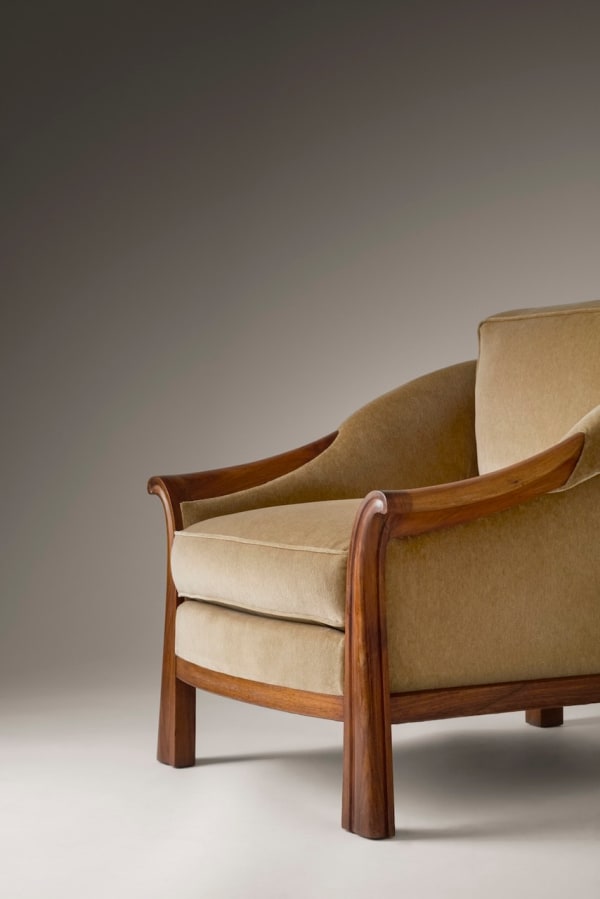
Pierre Chareau’s creative process is rooted above all in an architect’s way of thinking: observing space, studying its circulation, analysing the way light moves through it, and then designing furniture that integrates into the architecture and extends its lines, rather than simply being placed within it. This approach is particularly evident in one of his signature motifs: the use of the quarter-circle, a form dear to the Cubist vocabulary and present in several of his lighting designs. More than a graphic element, this geometric fragment structures emptiness, shapes light, and introduces a sense of constructive rigour into the decor.
“He perceives intuitively, organically, the intimate relationship between this new form and the age that calls it forth; he does not invent it arbitrarily, through a fleeting whim of personal taste: it imposes itself upon his ardent imagination, eager to translate the arrangements of our time into visible forms, just as the faithful rendering of a text imposes itself upon the translator.”
Les Arts de la Maison, “Nos décorateurs”, Edmond Fleg, Autumn–Winter 1924, p. 23, about Pierre Chareau.
Yet Chareau tempers this geometric rigour with a subtle reading of nature. It appears in the tulip-inspired low table, a motif he also explores in a low bookcase with organic contours. Together, they evoke a stylised plant form — both controlled and alive. His work thus oscillates between the precision of architectural planning and the sensuality of natural form.
This duality is also expressed in his use of materials. To rare wood veneers he associates metal, sandblasted glass, and perforated sheet metal — industrial materials he elevates to the status of noble substances. In doing so, he develops a singular language in which the warmth of a dark wood meets the crispness of sandblasted and blackened steel, as seen in the furniture created for the Maison de Verre (1928–1932), his masterpiece.
What fundamentally distinguishes Chareau from a decorator or an ébéniste is this intrinsically architectural approach: for him, a piece of furniture is never autonomous. It belongs to a system, responds to a movement, aligns with a grid. Each piece extends the building, to the point where visible hinges, structural joints, or lighting devices become architectonic gestures rather than decorative effects.
Pierre Chareau’s work thus remains profoundly modern: a rare balance between Cubist geometry, transfigured nature, and material experimentation — always guided by the vision of an architect who transforms furniture into architecture on an intimate scale.