



EUGÈNE PRINTZ
CABINET, 1935
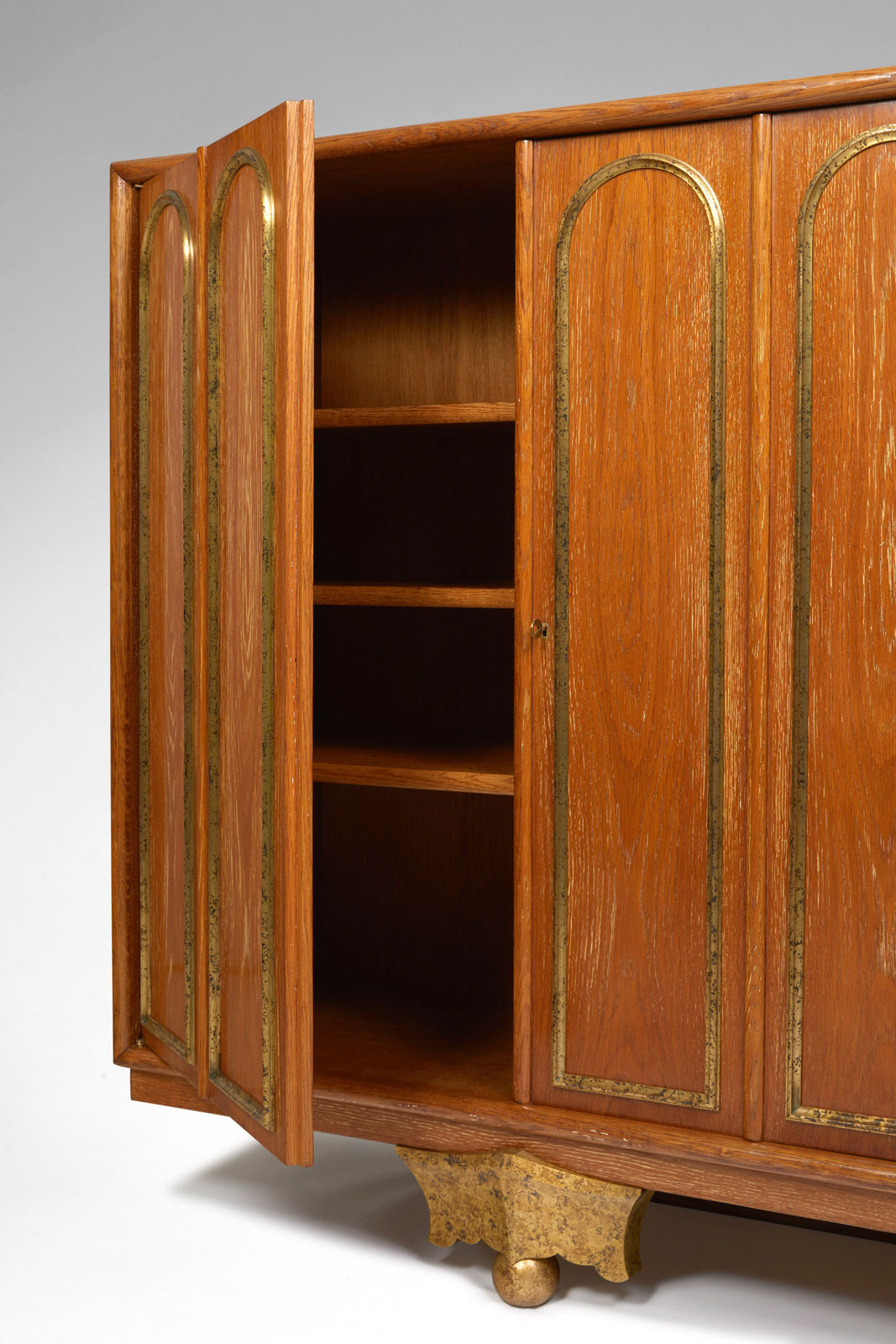
In blond oak, opening with four doors decorated with eight arches moulded in gilded brass.
Interior furnished with four height-adjustable shelves and sponge-oxidized brass front base, forming butterfly wings resting on spheres.
Interior furnished with four height-adjustable shelves and sponge-oxidized brass front base, forming butterfly wings resting on spheres.
120 x 240 x 40 cm.
47 1/4 x 94 1/2 x 15 3/4 in.
47 1/4 x 94 1/2 x 15 3/4 in.
Further images


Eugène Printz (1889–1948) is considered one of the most distinctive cabinetmakers of the Art Deco period. Trained within the family workshop in Paris’s Faubourg Saint-Antoine, he developed from the early 1920s a highly personal vocabulary—both architectural and refined—defined by the precision of his proportions, an exceptional sense of balance, and a constant exploration of materials and finishes.
One of Printz’s most recognizable signatures lies in his treatment of metal surfaces, notably his use of sponge-applied patination on brass. Rather than seeking uniformity, this technique creates subtly nuanced oxidations, giving the metal a vibrant, almost tactile quality. Neither fully matte nor reflective, the surface enhances the sculptural presence of the furniture while avoiding rigidity. Printz frequently employed this finish on bases, mounts, and structural elements, using it as a sophisticated counterpoint to light woods or precious veneers.In this cabinet, the dialogue between blond oak, the gilt-brass molded arcades, and the sponge-patinated brass base—designed as butterfly-wing forms resting on spheres—perfectly illustrates Printz’s approach: a quiet modernity in which technical mastery and material experimentation serve an understated yet unmistakable elegance.
One of Printz’s most recognizable signatures lies in his treatment of metal surfaces, notably his use of sponge-applied patination on brass. Rather than seeking uniformity, this technique creates subtly nuanced oxidations, giving the metal a vibrant, almost tactile quality. Neither fully matte nor reflective, the surface enhances the sculptural presence of the furniture while avoiding rigidity. Printz frequently employed this finish on bases, mounts, and structural elements, using it as a sophisticated counterpoint to light woods or precious veneers.In this cabinet, the dialogue between blond oak, the gilt-brass molded arcades, and the sponge-patinated brass base—designed as butterfly-wing forms resting on spheres—perfectly illustrates Printz’s approach: a quiet modernity in which technical mastery and material experimentation serve an understated yet unmistakable elegance.
Literature
Guy Bujon et Jean-Jacques Dutko, « E. Printz », Paris, Éditions du Regard, 1986, similar model p. 94Guy Bujon et Jean Jacques Dutko, « E. Printz », Paris, Éditions du Regard, 2018, similar model pp. 222-223 and 246-247
WELCOME TO GALERIE MARCILHAC NEWSLETTER
Please Join our mailing list by filling the form below
* denotes required fields
We will process the personal data you have supplied in accordance with our privacy policy (available on request). You can unsubscribe or change your preferences at any time by clicking the link in our emails.